I Went to Public School, My Brothers to Private — It Still Feels Unfair
The Disproportionate Impact on Girls’ Schools
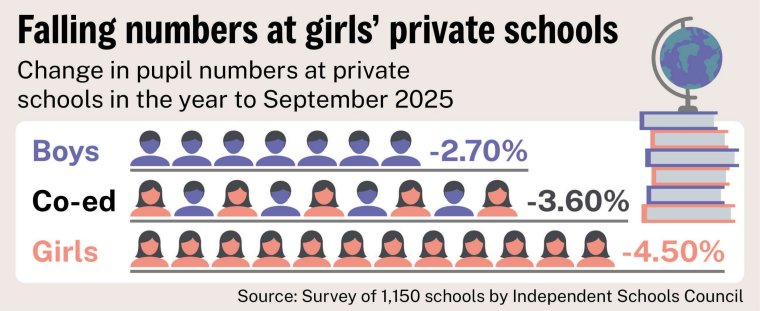
Private schools in the UK are experiencing a significant decline in student numbers, particularly among girls’ schools. A survey conducted by the Independent Schools Council (ISC) revealed that 81 schools have closed since July of last year, with nearly 17,000 pupils leaving the sector. This trend is not surprising given the imposition of VAT on school fees, but what has come as a surprise is the faster rate at which girls’ schools are losing students compared to boys’ or co-ed schools.
While boys’ schools have seen a loss of 2.7% of their pupils, girls’ schools have experienced a more severe drop of 4.5%. This discrepancy raises questions about societal values and priorities when it comes to education for boys and girls. Despite movements like Everyone’s Invited highlighting issues such as toxic masculinity and sexual harassment, it seems that parents may still be more inclined to invest in their sons' private education while opting for state schooling for their daughters.
This disparity in educational investment has historical roots. Boys’ public schools were established centuries before those for girls, and even the University of Cambridge did not offer women’s degrees until after World War II. These long-standing traditions have influenced modern-day decisions, often without conscious recognition.
Growing up in the 1980s in rural East Anglia, I witnessed firsthand how my brothers received a different education than I did. While I attended a local state primary and a cheap secondary school, my brothers were sent to expensive boarding schools. My parents spent around four times as much on their education, reflecting a broader pattern where girls’ education was considered less important.
This trend continued into adulthood. My husband was also sent to a boarding school while his sisters attended local schools. It wasn’t just about financial resources; there was an underlying belief that boys needed more academic and social opportunities, while girls could manage with less. This mindset persists today, albeit in more subtle forms.
Despite claims from some educators that parents are now equally invested in both sons and daughters, anecdotal evidence suggests otherwise. In many families, it is the girl who ends up in a less expensive or state school, while her brother receives private education. This pattern is not based on a lack of value for girls’ education, but rather on perceived needs and expectations.
Parents often justify these choices by citing differences in interests and activities. For example, one parent mentioned that their son requires extensive sports opportunities, which are not available in the local state school. Another parent noted that boys’ schools offer experiences that are not matched by girls’ institutions, leading to a preference for sending boys to independent schools.
The impact of this imbalance is evident in the performance of students. Research shows that girls’ schools consistently outperform boys’ schools in academic achievements, even after accounting for socioeconomic factors. However, the closure of girls’ schools due to financial pressures, including VAT, highlights a deeper issue of neglect and underinvestment.
Anna Paul, head of South Hampstead High School, emphasizes that girls’ schools historically lacked the endowments and financial support that boys’ schools enjoyed. VAT has only accelerated this decline, making it difficult for many girls’ schools to survive.
The implications of this trend extend beyond individual schools. The decline of girls’ schools could signal a regression in gender equality, as single-sex education has been shown to encourage girls to pursue subjects traditionally dominated by males, such as physics and computer science. Educators warn that this shift could negatively affect girls’ future opportunities.
While I may have excelled academically despite receiving a different education than my brothers, the sense of unfairness remains. The question of whether money spent equates to value given continues to linger, especially as girls’ schools face increasing challenges.